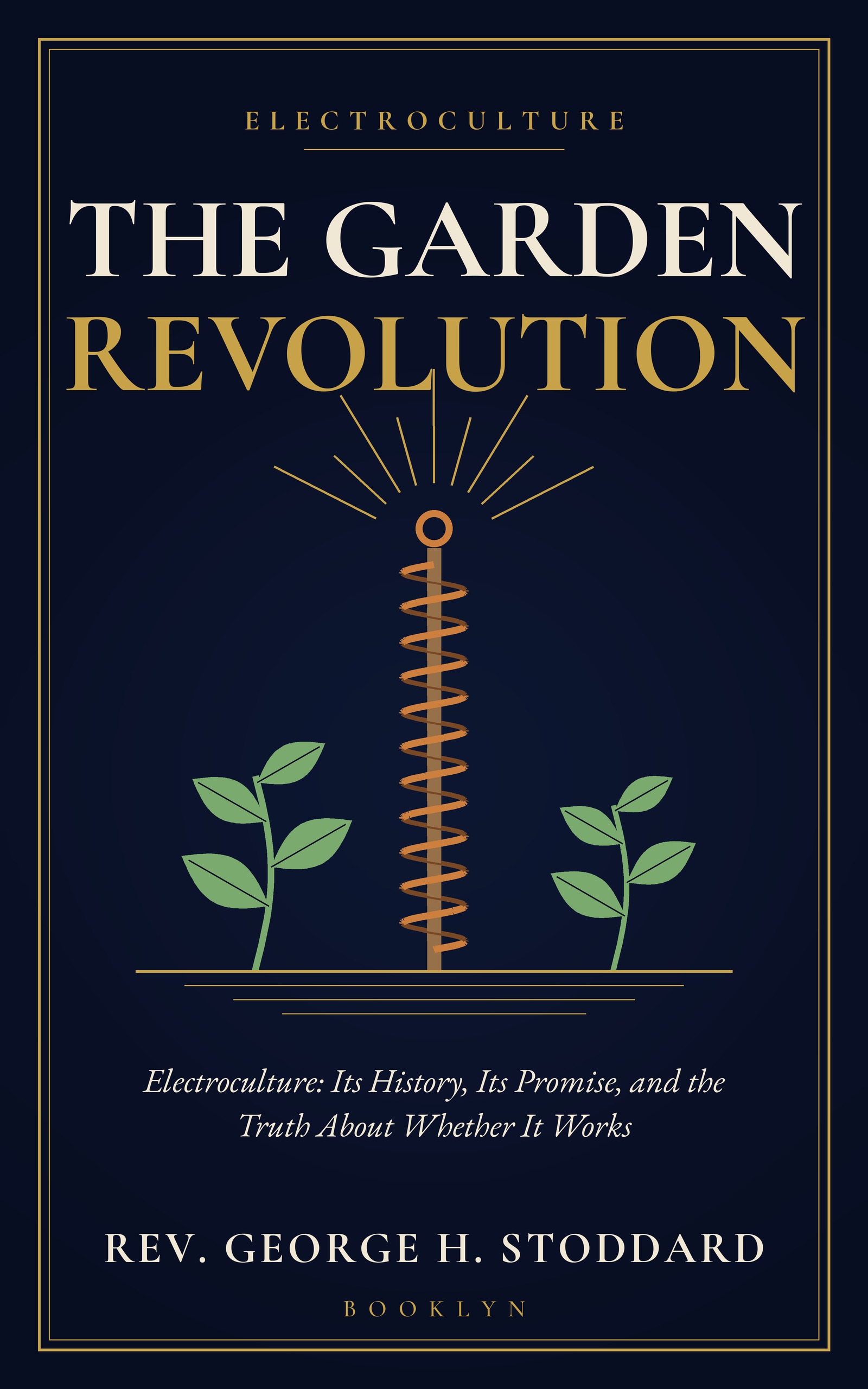
About the book
For nearly three hundred years, people have tried to grow more food with electricity. A copper coil on a wooden stake is only the latest chapter.
The Garden Revolution tells the whole story of electroculture: the Edinburgh myrtle trees of 1746, the French priest who built a mast to pull electricity from the sky, the Finnish physicist who strung wires over barley after studying the northern lights, the British government committee that tested it for eighteen years, and the Chinese greenhouses running at fifty thousand volts today.
It answers the questions gardeners actually ask. When did electroculture start? Who started it, and why? Was it hidden or suppressed by the fertilizer industry? And does it work?
The answers are honest ones. Some forms of electroculture have real experimental support. Others have none. This book separates them, shows the evidence for each, explains the physics in plain language, and then gives you a step-by-step method to test electroculture fairly in your own garden.
Includes a full timeline, glossary, safety guidance, and sources.
The four questions about electroculture
When did electroculture start?
The first recorded experiment was in 1746, when a Dr. Maimbray of Edinburgh electrified two myrtle trees. In 1783 the French priest Pierre Bertholon proposed it as a method for agriculture and described the first atmospheric collector, the electro-vegetometer.
Who invented electroculture?
No single person. Early experimenters included Maimbray and the Abbé Nollet in the 1740s and Bertholon in 1783. The modern powered method, a charged wire network over the crop, was developed by the Finnish physicist Selim Lemström from 1885.
Was electroculture hidden or suppressed?
The documentary record does not show deliberate suppression. Electroculture was tested publicly by the British and United States governments between 1907 and 1936 and set aside because results were inconsistent and fertilizer was cheaper and more reliable. The British committee’s reports were, however, never widely published.
Does electroculture work?
It depends on the type. Powered high-voltage fields over crops have shown yield increases of roughly 20 percent in several independent studies, mainly in greenhouses, though results are inconsistent. Passive copper coil antennas have no controlled evidence supporting them, and the atmospheric energy available to them is negligible.
Table of contents
- Part One · The Spark
- 1. The Question in the Garden
- 2. The Electric Century
- 3. Bertholon and the Electro-Vegetometer
- 4. The First Skeptic
- Part Two · Wires in the Field
- 5. The Scottish Barley Craze
- 6. Grandeau’s Cage
- 7. Lemström and the Northern Lights
- 8. Lodge, Newman, and Evesham
- Part Three · The Great Trial
- 9. Blackman’s Numbers
- 10. The Electro-Culture Committee
- 11. America Says No
- 12. Christofleau, Lakhovsky, and the Antenna Dream
- Part Four · Was It Hidden?
- 13. The Case for Suppression
- 14. What the Record Shows
- 15. The Quiet Years
- Part Five · Does It Work?
- 16. What a Plant Is, Electrically
- 17. How Much Electricity Is in the Sky?
- 18. China’s Electric Greenhouses
- 19. The New Laboratory Evidence
- 20. The Copper Coil on Trial
- 21. The Verdict
- Part Six · Your Garden
- 22. How to Run an Honest Trial
- 23. Building, and Staying Safe
- 24. The Real Garden Revolution
- Timeline
- Glossary
- Sources and Further Reading
- About the Author
Download
EPUB e-book
For Kindle, Apple Books, Kobo and other e-readers. Cover and linked table of contents included.
PDF edition
79 pages, 6 × 9 in, with cover, description and table of contents.
Audiobook script (PDF)
Narration-ready script with pronunciation guide, about 1 hr 30 min.